Folic Acid: Why It Matters Before and During Pregnancy
18.6.2026 · 4 min reading
If there is one supplement that fertility specialists and obstetricians consistently agree on, it is folic acid. Unlike many nutritional recommendations that come and go, the evidence here is clear and longstanding: getting enough folic acid before and during early pregnancy makes a genuine difference. Here is what you need to know.
If there is one supplement that fertility specialists and obstetricians consistently agree on, it is folic acid. Unlike many nutritional recommendations that come and go, the evidence here is clear and longstanding: getting enough folic acid before and during early pregnancy makes a genuine difference. Here is what you need to know.
What Is Folic Acid and What Does It Do?
Folic acid is the synthetic form of folate — a water-soluble B vitamin (B9) that the body cannot manufacture on its own. It has to come from food or supplements. Its role in the body goes well beyond pregnancy:
- Formation and maturation of red blood cells
- Cell division and growth
- Synthesis of DNA and RNA
- Development of the neural tube in the embryo during the earliest weeks of pregnancy
- Support of the immune system
That last point is the reason folic acid receives so much attention in reproductive health.
Why Folic Acid Matters When You Are Trying to Conceive
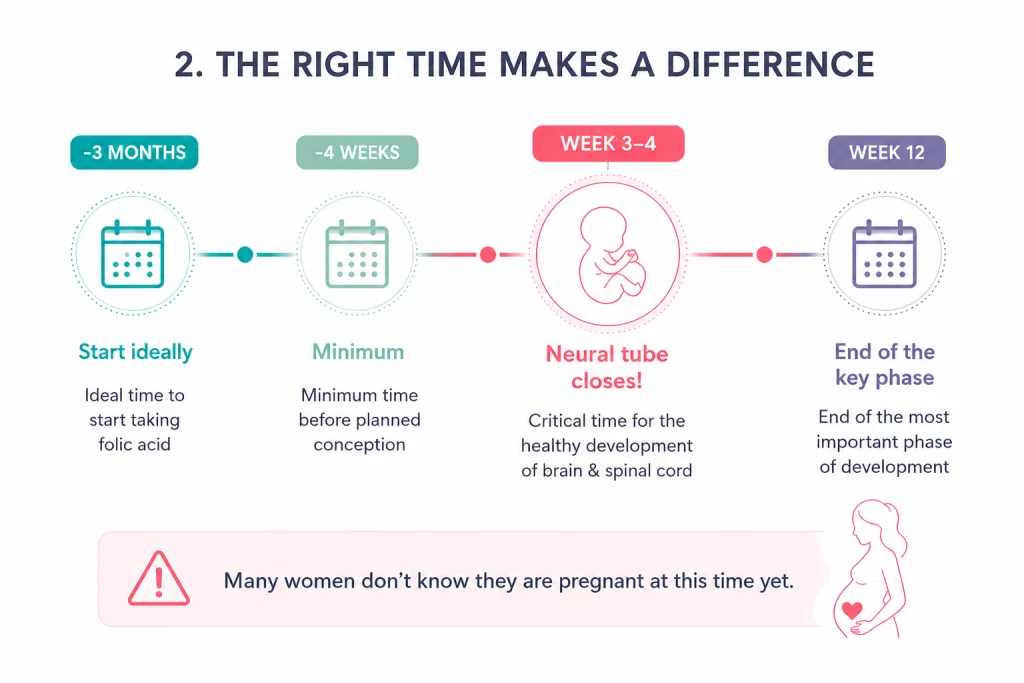
The neural tube — the structure that develops into the baby’s brain and spinal cord — closes somewhere between weeks three and four of pregnancy. That is often before a woman even knows she is pregnant. If folate levels in the body are insufficient at that precise moment, the risk of neural tube defects such as spina bifida rises significantly. Research consistently shows that adequate folic acid intake can reduce that risk by up to 70%.
Most women start thinking about supplements after a positive test. By then, the neural tube — which becomes the brain and spinal cord — has already closed. That happens somewhere around week three or four, usually before a period is even missed. The body needs folate already circulating at that point, not just arriving.
Starting four weeks before conception is the bare minimum most guidelines suggest. Three months is more sensible in practice — it gives levels time to actually stabilise rather than just tick upward. And it is not only about the neural tube: folate also plays a part in how eggs mature and how the cycle functions, so earlier is better for more than one reason.
How Much Should You Take?
Dosage recommendations vary depending on individual circumstances:
- When trying to conceive and during pregnancy: 400–800 µg daily
- High-risk cases (for example, after a previous pregnancy affected by a neural tube defect): up to 4 mg daily — but only under medical supervision
Those numbers are a starting point. If you have had a pregnancy affected by a neural tube defect before, your doctor will likely recommend significantly more — up to 4 mg — but that is a conversation to have rather than something to self-prescribe.
Can You Get Enough Folic Acid From Food Alone?
Folate is naturally present in a wide range of foods:
- Green leafy vegetables — spinach, broccoli, lamb’s lettuce
- Legumes — lentils, chickpeas, beans
- Wholegrains and wheat germ
- Yeast
- Oranges and orange juice
- Liver — though this should be consumed only in moderation during pregnancy due to its high vitamin A content
The catch with food sources is that folate does not survive well. Cooking degrades it, and so does light — so by the time spinach or broccoli reaches your plate, a good portion of the folate content is already gone. You can eat well and still fall short of what early pregnancy actually demands. A daily supplement is the practical answer, and it is what most guidelines recommend regardless of diet quality.
Folic Acid and Male Fertility
Folic acid tends to get framed as something for women, but men have reason to pay attention too. Some studies have found that taking folic acid together with zinc has a measurable effect on sperm quality. It is not a dramatic intervention — but when both partners are trying to optimise their chances, it is an easy one to add.
When Should You Start?
The four-week figure comes up constantly, but it is really a floor rather than a target. Starting three months out means that by the time conception happens, folate is not still catching up. Keep taking it until week 12 — that covers the stretch of pregnancy when the baby’s organs are developing fastest and the demand is highest.
Folic Acid in IVF, ICSI and IUI
Anyone going through IVF, ICSI or IUI will already be thinking carefully about preparation. Folic acid is part of that from the start at our clinic — not as a formality, but because the nutritional groundwork genuinely matters. There is not much point putting significant effort and resources into treatment while overlooking something this straightforward.
Worth Starting Sooner Rather Than Later
Folic acid does not have the complexity of many fertility topics — the research is consistent, the supplement is inexpensive, and taking it is not difficult. What catches people out is the timing. The window that matters opens earlier than most people realise, and it closes before a pregnancy is even confirmed. If there is any chance you might be trying in the coming months, starting now makes more sense than waiting until you are sure.
Any questions about dose or when to start? We are glad to help.